Review · Wood-Fired
Sweat Tent Review: The Only Portable That Reaches Real Finnish Heat
How to read this page: This is a research-based assessment. We do not test units in-house; we work from published specifications, manufacturer documentation, regulatory filings and owner reports, and we say so wherever a number comes from the brand itself. Prices checked November 2026 — they change, and the seller's page wins.
Most products sold as “portable saunas” top out somewhere between 110°F and 170°F, depending on the format. The Sweat Tent is the outlier in the entire category, and it gets there the old way: with an actual fire. The complete kit — tent, wood-burning stove, sauna stones and a bench — is listed at $1,499, and the published operating range is 180–220°F. That is the temperature band of a traditional Finnish sauna, and no steam tent, infrared tent or blanket in our research reaches it. That single fact is the whole case for this product. Everything else about it — and there is a lot of “else” — is the price you pay in effort, space and planning for heat that nothing else portable can match.
$1,499 complete kit — tent, stove, stones and bench included
Prices change — the seller's page wins. Confirm the current kit contents and price there before you buy.
How a wood-fired tent sauna actually works
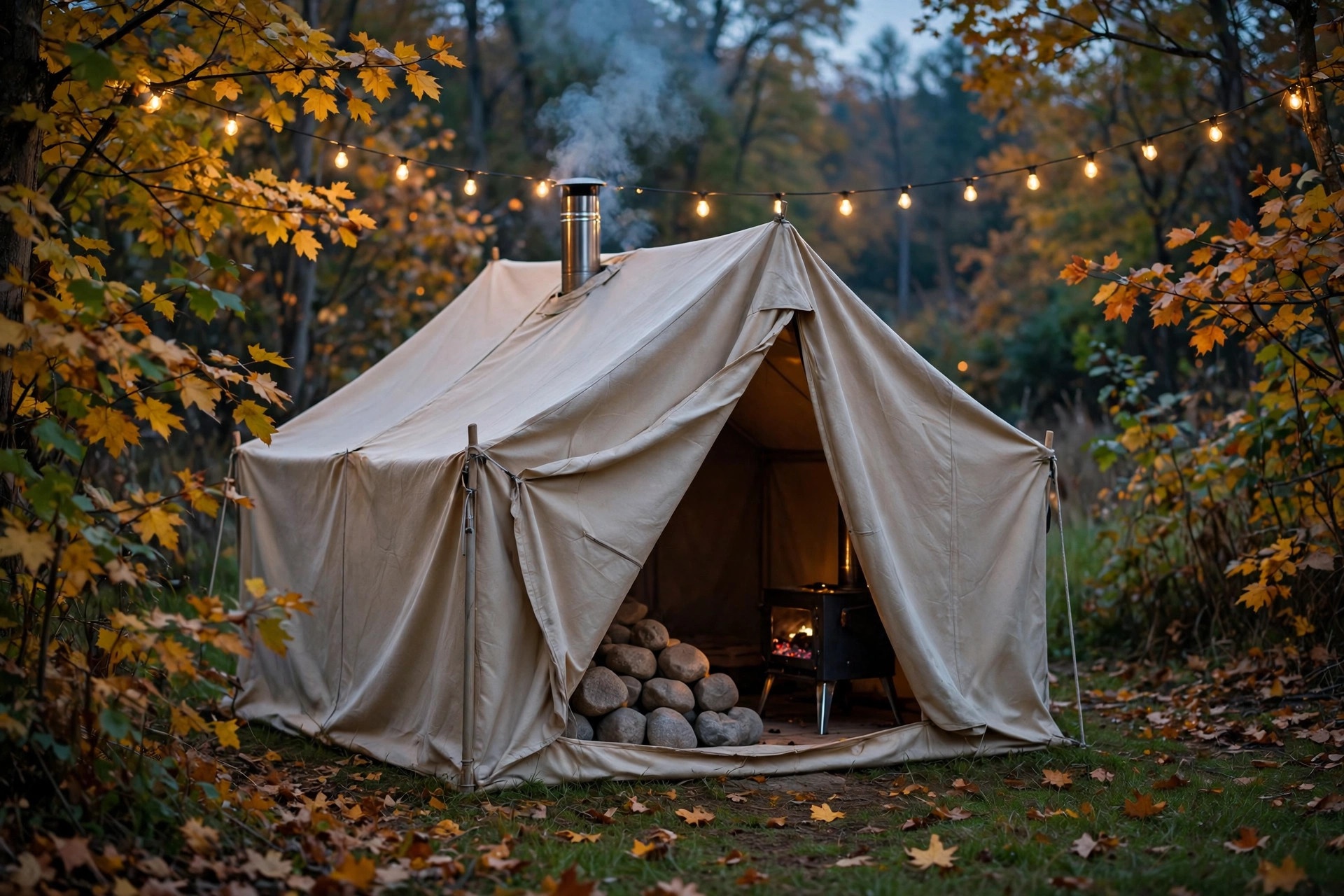
The design is simple, and that simplicity is the point. An insulated canvas tent is pitched outdoors. Inside it sits a small wood-burning stove, with a chimney that vents up and out through the tent so smoke leaves the space instead of filling it. On top of, or around, the stove sits a load of sauna stones. You build a fire in the stove, the fire heats the metal and the stones, and the stones and stove together heat the air inside the tent. There is no thermostat dial in the electric sense and no heating panel: the fire is the heater, and you are the control system. Feed the fire and the temperature climbs; let it settle and the temperature eases.
The stones are not decoration. In a Finnish sauna, water is ladled onto hot stones to produce a burst of steam — the practice known by the Finnish word löyly. The steam raises the humidity inside the tent for a short period and makes the heat feel more intense on the skin, then it dissipates and the air returns to hot and comparatively dry. The Sweat Tent's kit includes stones for exactly this purpose: once the tent is up to temperature, a small amount of water on the stones gives you that same steam burst, in a tent, in your own yard. It is worth being precise about what this is: it is a traditional heat-and-steam ritual, described here as an experience of warmth and relaxation. We do not repeat the stronger claims that circulate in sauna marketing — the published evidence does not support promises beyond comfort, warmth and routine, and this site does not make them.
Because the heat source is combustion, the experience is different in character from an electric tent. Owner reports consistently describe the heat as enveloping and “real” in a way they contrast with infrared panels, and the ritual itself — splitting or stacking wood, lighting the stove, waiting, tending — is part of what buyers say they enjoy. Other buyers, just as consistently, discover that the ritual is also the workload. Both things are true, and which one dominates depends entirely on the person.
Heat-up and fire management: the honest effort account
A push-button sauna this is not. Every session begins with setup and fire work: pitching or checking the tent, loading the stove, lighting the fire, and tending it while the tent comes up to temperature. Fire management continues, at a lower level, during the session itself — someone needs to keep an eye on the stove and add wood as needed to hold the temperature in the band you want. Reaching 180–220°F is genuinely achievable with this format, which is precisely why people buy it, but the temperature is earned rather than selected. If your picture of a home sauna session is “press start, step in twenty minutes later,” the gap between that picture and this product is the single most important thing in this review.
There is also a learning curve. Fires behave differently in wind, in cold weather and with different wood, and your first sessions will involve more adjusting than your tenth. Manufacturer documentation and owner reports both frame this as normal for wood-fired heating of any kind — the same learning curve applies to a wood stove in a cabin. None of it is difficult in a technical sense, but all of it is time and attention, every single session, with no shortcut.
The outdoor-only reality
The Sweat Tent is an outdoor product, full stop. It needs a yard, a deck or another suitable outdoor space where a tent with a chimney can stand and a fire can burn. That means several practical checks before the $1,499 makes sense. First, space: you need room for the tent itself plus sensible clearance around a hot stove and chimney. Second, fire safety: a wood stove inside a fabric tent demands respect — level ground, attention while burning, a plan for ash and embers, and keeping the setup away from anything combustible. Third, and most often skipped: local rules. Fire regulations, burn restrictions and rules about outdoor burning vary widely by city, county, HOA and season, and they can change during dry or high-risk periods. Check yours before you buy, not after the tent arrives. A product that is perfect in a rural yard in a cold climate may be unusable in a dense suburb during a summer burn ban.
Weather is part of the package too. The tent is built for outdoor use, but wind, rain and snow all affect setup, heat-up and how pleasant a session is. Cold-climate owners often report the opposite problem from the one people expect — the contrast between a very hot tent and cold air outside is, for many, the best part of the ritual. But a session still starts with you outside, in that weather, building a fire.
No electricity, and what pack-down really involves
The format's other genuine advantage is independence from power. The Sweat Tent needs no electricity at all: no outlet, no circuit capacity to check, no running cost for the heater beyond firewood. That makes it usable in places an electric sauna simply cannot go — an off-grid cabin, a large rural property, a campsite where fires are permitted. For buyers whose interest in a sauna is tied to a cabin or a homestead-style property, this is not a minor convenience; it is the reason the product exists.
“Portable,” though, needs an honest definition. This is portable in the sense that it packs down and can be stored or transported — it is not a permanent structure and needs no foundation or installation. It is not portable in the sense of effortless. Pack-down means letting the stove cool fully, dealing with ash, folding a large tent, and storing the kit somewhere dry. Fabric that goes away damp will not thank you for it, and the smoke smell that clings to the tent material is a recurring theme in owner reports: after sessions, the kit smells like a campfire, because in a real sense it has been around one. Many owners like that. If you plan to store the kit in a small indoor closet, go in with your eyes open.
What we like
- 180–220°F — true Finnish sauna temperatures no other portable format reaches
- Complete $1,499 kit: tent, stove, stones and bench in one purchase
- Water on hot stones gives the traditional löyly-style steam burst
- No electricity needed — works off-grid, at cabins, anywhere fires are allowed
- Packs down for storage; no foundation, wiring or permanent installation
Honest downsides
- Real labour every session: setup, lighting and tending a fire, teardown
- Outdoor only — needs a yard or deck and room around a hot stove and chimney
- Local fire rules and seasonal burn restrictions may limit or bar use
- Weather-dependent: wind and rain affect heat-up and the whole routine
- Smoke smell settles into the fabric; ash and full cool-down are part of pack-down
Who it's for — and who should skip it
Who it's for: Heat purists, first of all — people who have used a traditional Finnish sauna, know what 190°F air with steam on the stones feels like, and have been disappointed by every gentler substitute. If that is you, this is currently the only portable route to the real thing. It also suits off-grid and cold-climate owners: cabin owners, rural households, and anyone for whom the fire ritual is a feature — an unhurried, hands-on routine at the end of the day rather than a chore. If you enjoy tending a wood stove in winter, you already understand this product.
Who should skip it: Apartment renters, almost without exception — there is no version of a wood fire in a tent that works on a balcony or in a rented unit, and most leases and local rules will say so plainly. Skip it, too, if you want push-button convenience: anyone whose routine needs to start on a timer and run unattended should look at the electric formats covered in our infrared guide or steam guide instead. And skip it if you live somewhere with strict or frequently active fire restrictions — a sauna you are not allowed to light for much of the year is an expensive storage problem.
Before any sauna session
Start with short sessions, hydrate, and build up gradually. Ask a doctor first if you are pregnant, have a health condition, or take medication. With a wood-fired product, add the fire rules: never leave a burning stove unattended, let everything cool fully before pack-down, and follow your local fire regulations. Nothing on this page is medical advice.
Price note and verdict
At $1,499 for the complete kit, the Sweat Tent sits between the budget electric tents and the premium infrared models — and it is not really competing with either. Against a built Finnish sauna, which involves construction, wiring and a far larger budget, $1,499 for genuine 180–220°F heat is the entire pitch. Prices checked November 2026; prices change, and the seller's page wins — confirm the current price, kit contents and warranty terms at the brand's site before buying. You can also compare formats in our guide to how portable saunas work and our best portable saunas roundup.
Our verdict, on the published evidence: the Sweat Tent does the one thing it promises — real Finnish temperatures from a packable kit — and it is honest work to get them. Buy it for the heat and the ritual, with a yard, a woodpile and local rules that allow fires. Want the heat without the fire? No electric portable matches this temperature; the closest comfort-first alternatives are the premium infrared format in our Relax Sauna review and, at the budget end, the steam format in our SaunaBox SmartSteam review — both honest products, at honestly lower temperatures.
Price checked November 2026: $1,499 complete kit. Prices change — the seller's page wins.